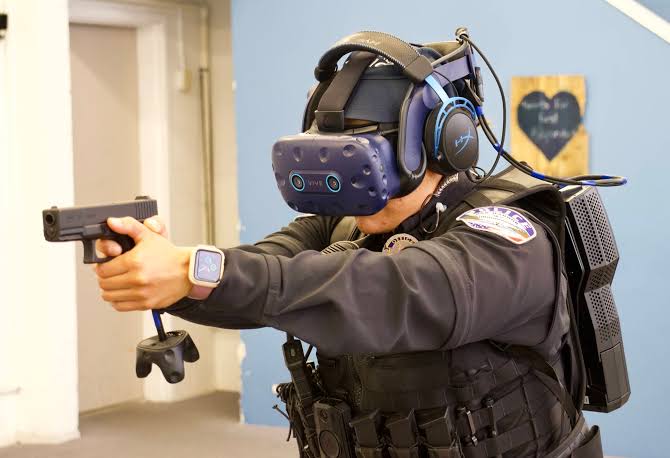
Working in a correctional facility can be quite unpredictable, with ordinary situations capable of becoming dangerous within moments. A routine conversation in a housing unit, an intake procedure, or an interaction with an inmate can quickly change because of behavior, group dynamics, officer positioning, or environmental factors. Preparing corrections officers for these unpredictable situations has traditionally been difficult. Fortunately, modern corrections officer VR training simulator can provide a more immersive and adaptable way to prepare personnel for the realities of the job.
The role of virtual reality (VR) simulators in modern corrections training
Classroom education remains an important part of corrections training, but lectures and discussions cannot fully reproduce the pressure of working in a confined facility or dealing with an agitated or manipulative inmate. Live role-playing exercises can provide more realism, yet they require significant planning, space, equipment, and personnel. As a result, conducting these exercises regularly can be challenging.
Older simulation systems can also have limitations. Many depend on prerecorded or scripted video scenarios that provide only predetermined outcomes. Although these tools can introduce officers to potential situations, they may not adequately develop adaptability, communication, or judgment. Another challenge is that generic scenarios may not accurately represent individual facilities. Every jail and prison has different layouts, procedures, populations, policies, and operational priorities.
New age corrections officer VR training simulators are designed to manage these challenges. They allow agencies and instructors to have greater control over training content. Instead of depending entirely on a vendor’s scenario library, trainers can develop exercises that reflect their own facilities, procedures, and challenges. Instructors can participate in scenarios as inmates, visitors, or other personnel while the trainee interacts naturally within the virtual setting. They can also modify situations as training progresses. For example, an instructor can make an inmate more cooperative, introduce a distraction, increase tension, or alter circumstances depending on how the officer responds. This creates a more dynamic experience in which trainees must make decisions rather than simply follow a predetermined sequence.
The flexibility of VR makes it useful for many areas of corrections training. Scenarios can cover inmate supervision, housing unit operations, intake and booking, segregation procedures, transportation, medical emergencies, facility disturbances, and other critical incidents. Communication and de-escalation can also be incorporated into many of these exercises. Officers can practice remaining calm, recognizing warning signs, communicating effectively, and making appropriate decisions when circumstances become increasingly difficult. Repeated exposure to realistic situations can help personnel build confidence while improving situational awareness and judgment.
As correctional agencies continue to address staffing challenges and increasing expectations for officer safety and professionalism, accessible and realistic training tools are becoming increasingly valuable. In many ways, VR simulation provides a practical bridge between classroom education and real-world experience. By enabling officers to repeatedly practice communication, decision-making, de-escalation, and emergency response in immersive environments, VR training simulators can significantly help corrections personnel become better prepared for the unpredictable situations they may encounter on duty.